Understanding Mother Teaching Child Line Art: A Guide to Minimalist Family Illustrations
In the realm of visual storytelling and educational resources, Mother Teaching Child Line Art has emerged as a distinct aesthetic choice that resonates with modern audiences. This style moves away from the cluttered, hyper-realistic, or overly saturated imagery often found in traditional stock photography. Instead, it relies on continuous lines, clean outlines, and monochrome palettes to depict the profound connection between a parent and a learner. For designers, educators, and parents seeking materials for books, school projects, or home decor, understanding the nuances of this specific artistic approach is essential for making informed decisions about its application.
The Distinctive Nature of Continuous Line Illustrations
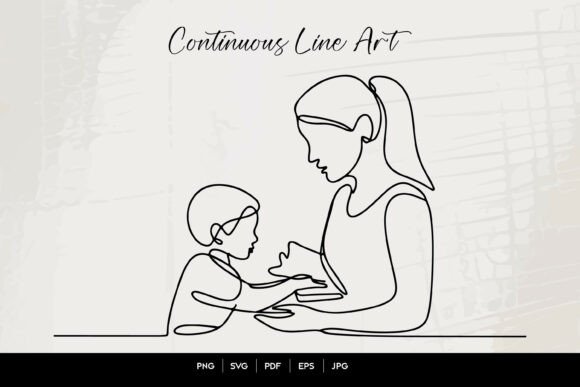
Mother Teaching Child Line Art is defined by its economy of form. Unlike detailed vector illustrations that use gradients, shadows, and complex textures to create depth, line art utilizes the flow of a single or few strokes to define shape and emotion. When depicting a mother teaching a child, the artist focuses on the posture, the gesture of guidance, and the proximity of the figures rather than facial details or background distractions.
This minimalist approach offers several unique advantages. First, it creates a sense of timelessness. Because the images lack specific fashion trends or dated technological props, they remain relevant across decades. Second, the simplicity allows for versatility in color application. A black-and-white outline can be easily adapted to fit various brand guidelines, classroom themes, or personal color schemes without losing its integrity. Whether downloaded as a high-resolution PNG for digital use or an SVG for scalable print applications, the core message of care, learning, and bonding remains clear and unambiguous.
Comparing Line Art with Other Visual Styles
When evaluating resources for educational materials or family-themed decor, it is crucial to compare Mother Teaching Child Line Art against other prevalent styles such as watercolor, photorealism, and flat design.
- Photorealism: Stock photos offer authenticity but can feel intrusive or too specific for certain contexts. A photo might capture a specific moment, but it also captures specific lighting, clothing, and expressions that may not align with a universal message. Line art abstracts these details, allowing viewers to project their own experiences onto the image.
- Watercolor and Painterly Styles: These styles evoke emotion through texture and color blending. While beautiful, they can sometimes obscure the specific action being depicted. In an educational setting where clarity is paramount, the soft edges of watercolor might be less effective than the crisp definition of line art.
- Flat Design: Similar to line art in its simplicity, flat design uses solid blocks of color. However, Mother Teaching Child Line Art often retains a sketch-like quality that feels more organic and human. The "continuous line" technique, in particular, mimics the motion of a hand drawing, adding a layer of warmth that rigid geometric flat design lacks.
The decision often comes down to the intended medium. For a children's book cover requiring bold impact, flat design or watercolor might be preferred. However, for interior pages, worksheets, or wall art where the text needs to take precedence, the non-intrusive nature of line art makes it a superior choice.
Evaluating Formats and Technical Considerations
A significant factor in choosing Mother Teaching Child Line Art is the availability of various file formats. Understanding the tradeoffs between these formats ensures the artwork performs well in its intended environment.
Scalability and Vector Formats (SVG, EPS)
For professional printing, large-scale wall art, or logos, vector formats like SVG and EPS are indispensable. These files are mathematically defined, meaning they can be scaled infinitely without losing resolution. If you plan to print a poster featuring a mother guiding her son at a desk, a vector file ensures the lines remain sharp whether printed on a business card or a billboard. This scalability is a primary reason why many graphic designers prefer line art; the clean strokes translate perfectly into vector paths.
Raster Formats (PNG, JPG, PDF)
Raster formats like PNG and JPG are standard for web use, social media, and digital presentations. A transparent PNG is particularly useful for overlaying line art onto colored backgrounds or integrating it into website headers. PDF files serve a dual purpose, offering both print-ready quality and easy sharing for educational handouts. While raster images have a fixed resolution, high-quality downloads ensure that Mother Teaching Child Line Art looks crisp on screens up to 4K resolution.
The limitation of raster formats is that they cannot be resized significantly beyond their original dimensions without pixelation. Therefore, when selecting resources, it is vital to verify the DPI (dots per inch) if the end goal involves physical printing. For most digital applications, however, the flexibility of PNG and JPG outweighs the need for vector scalability.
Best Use Cases and Practical Applications
The utility of Mother Teaching Child Line Art extends across multiple sectors, each benefiting from its specific aesthetic qualities.
Educational Resources and Literacy Materials
In the context of education, clarity is key. Teachers and curriculum developers often use line art for coloring pages, reading comprehension exercises, and flashcards. The absence of distracting colors allows children to focus on the narrative or the lesson. Furthermore, the act of coloring line art itself becomes a learning activity, enhancing fine motor skills while reinforcing the theme of family support and education. When creating study guides or homework sheets, these illustrations provide a gentle, encouraging visual anchor.
Home Decor and Wall Art
For homeowners, particularly those embracing a modern, Scandinavian, or minimalist interior design, line art serves as sophisticated decor. A framed print of a mother and child studying together can transform a nursery, home office, or library. Unlike busy photographs, line art blends seamlessly with neutral walls and furniture, acting as a subtle reminder of the values of knowledge and affection. The monochrome nature of the art allows it to coordinate with existing color palettes without clashing.
Digital Content and Branding
Parents bloggers, parenting coaches, and educational startups frequently utilize this style for blog headers, social media graphics, and eBook covers. The aesthetic signals professionalism and warmth simultaneously. It avoids the "clipart" look of older, low-quality graphics while remaining accessible and friendly. In a crowded digital landscape, the clean lines help content stand out, ensuring that the message regarding parenting, guidance, and literacy is communicated effectively.
Tradeoffs and Limitations to Consider
While Mother Teaching Child Line Art offers numerous benefits, it is not a one-size-fits-all solution. Prospective users should weigh the limitations before committing to this style.
Lack of Emotional Nuance: Detailed facial expressions are often difficult to convey in minimal line work. While the body language suggests affection and teaching, subtle emotions like frustration, joy, or confusion may be lost. If the specific emotional state of the characters is critical to the narrative, a more detailed illustration style might be necessary.
Contextual Ambiguity: Without background elements, the setting can be ambiguous. Is the scene taking place in a formal school, a cozy living room, or a park? While this abstraction is often a strength, it can be a drawback if the specific environment needs to be established. Users may need to add contextual elements separately or choose a version that includes minimal background cues.
Suitability for Younger Children: Very young children sometimes struggle to interpret abstract representations. They may find it harder to connect with a simple outline compared to a colorful, realistic image. For early childhood materials targeting toddlers, more vibrant and detailed imagery might be more engaging.
Decision Factors for Selecting the Right Resource
When deciding if Mother Teaching Child Line Art is the right choice for your project, consider the following factors:
- Target Audience Age: Is the material for toddlers, school-aged children, or adults? Older audiences generally appreciate the sophistication of line art, while younger ones may require more detail.
- Medium of Delivery: Will the image be viewed on a screen, printed on paper, or displayed as a large poster? Ensure the file format (SVG vs. PNG) matches the technical requirements.
- Desired Tone: Do you want the image to feel academic and structured, or warm and organic? Continuous line art leans towards the latter, while strict geometric outlines feel more structured.
- Customization Needs: Do you need to change the colors or integrate the image into a larger layout? Line art offers the highest degree of customization due to its simplicity.
Ultimately, the value of Mother Teaching Child Line Art lies in its ability to distill complex human interactions into their purest form. It celebrates the bond of motherhood, the act of teaching, and the journey of learning without unnecessary distraction. By understanding its strengths, comparing it to alternatives, and recognizing its limitations, creators and consumers can leverage this powerful visual tool to communicate messages of love, care, and education with clarity and elegance.